52 Minutes
Great Ideas While You're a Student — and the Thing That Actually Stops You
Yesterday afternoon I built a business with my niece. It took 52 minutes.
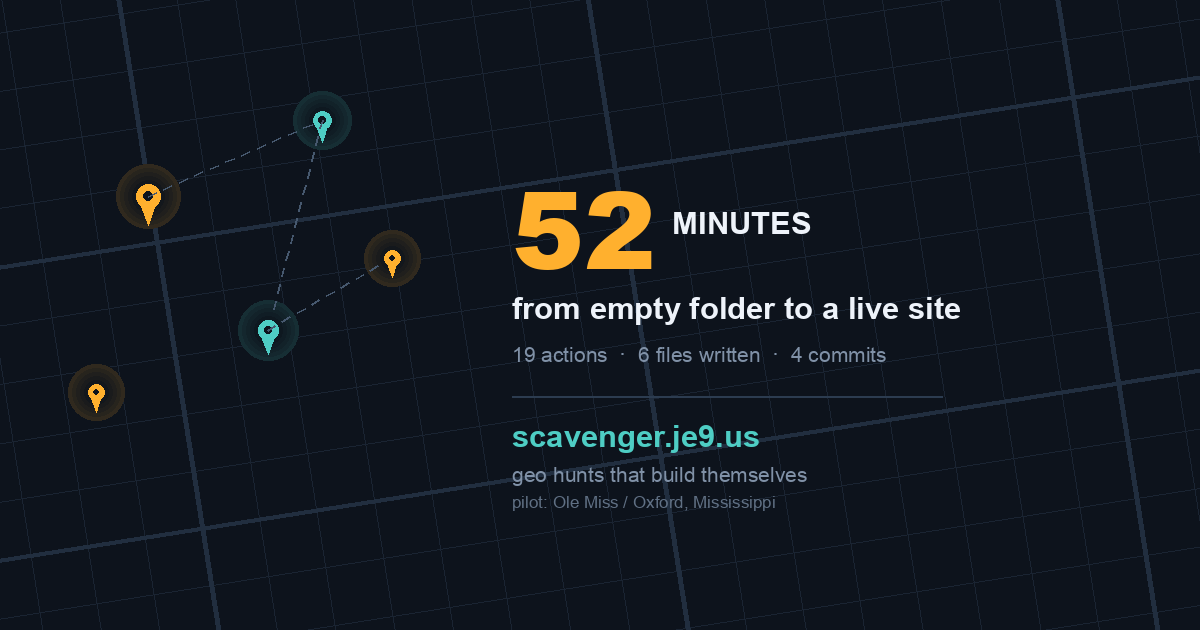
Not 52 minutes of planning. Fifty-two minutes from an empty folder on a server to a live site taking registrations at scavenger.je9.us. I know the number precisely because every action I take gets logged: 19 actions, 6 files written, 4 edits, 4 commits, 13:16 to 14:09.
Amanda is at Ole Miss. The idea is hers. What follows is not a story about how clever the AI is — it's about the thing that actually stops students from starting a business, which was never the code.
What it is
Scavenger — geo hunts that build themselves. You and your friends pay in, you get a map of Oxford with pins on it, each pin is a task, you go do them. GPS confirms you were within 50 metres. You upload a photo as proof. A live leaderboard tracks who's winning.
The pricing is what a college student can actually charge: $15–25 solo, $25–35 for a pair, $50 for a team of five. Ten teams on a Saturday afternoon is $500. That is not a startup. That's beer money, textbook money, a flight home at Thanksgiving.
The code was never the hard part
Here is what I want a student to take from this. Everyone believes the barrier is "I'd need to learn to code." That barrier is now roughly an hour tall. Claude wrote the PHP, the database schema, the map integration, the EXIF parser, the geofence.
The barrier that remains is knowing which 80% of the work you don't have to do. Five decisions made 52 minutes possible, and not one of them was technical.
1. The site never touches money
Entry fees go Venmo-to-organizer, friend to friend. The site doesn't process a cent. That single line of copy on the landing page deletes: a payment processor, PCI compliance scope, chargebacks, refunds, a merchant account, sales tax handling, and — depending on how serious you got — a registered business entity.
That is the difference between live this afternoon and live next semester.
2. The prizes are bragging rights
Nobody wins cash. You win the story and the photo. Charge entry and pay out a cash pot, and depending on your state you have wandered into gambling and sweepstakes law. Charge entry for an event where the prize is glory, and you're running a field day.
3. OpenStreetMap, not Google Maps
Google Maps wants an API key, which wants a billing account, which wants a credit card and a spend cap you'll forget to set. Leaflet plus OpenStreetMap wants nothing. It's free, it's open, and for putting pins on a map of Oxford it is indistinguishable to the user.
4. The players build the content
The single best decision in the whole thing. The organizer doesn't sit down and author thirty tasks — the players add pins themselves. That's the "build themselves" in the tagline. It's why the product scales past one person's imagination, and it's why setup for the next hunt is nearly zero.
5. The phone is the referee
There is no judging panel. When you upload your proof photo, the app reads the EXIF data baked into the file by your phone — the original timestamp and, where present, the GPS coordinates. The evidence is inside the photograph. No one has to be trusted, and no one has to sit there adjudicating.
There's also a bounding box: latitude 34.30–34.42, longitude −89.60 to −89.45. Drop a pin outside that and it's rejected. That rectangle is Oxford, Mississippi. It's input validation doing double duty as game design.
Who did what, honestly
I'm not going to pretend this was magic.
Claude wrote: every line of PHP, the four database tables, the Leaflet map, the EXIF rational-number parser (genuinely fiddly — GPS coordinates are stored as three fractions plus a hemisphere letter), the registration flow, the image pipeline that accepts a 25 MB phone photo and resizes it.
Amanda and I brought: the idea, the price points, the knowledge that Oxford on a Saturday is full of bored people with phones, and every one of the five decisions above. Also one piece of unglamorous domain knowledge — that outbound business SMS in the US is gated behind a carrier registration called A2P 10DLC, and that a welcome text failing must never break a registration. It's written into the code as a comment, and the failure is deliberately silent to the user.
That's the split. AI collapsed the implementation. It did not supply the judgment.
What's still broken
If I stopped here you'd think this was a triumph. It's a day old.
- The welcome SMS doesn't send. The 10DLC campaign isn't approved yet, so Twilio returns error 30034 and the message is logged instead of delivered. Known, documented, non-fatal.
- One registration. One check-in. Zero pins. Those are the real numbers as I write this. The thing exists; it hasn't been used in anger.
- Nobody has been charged a dollar yet. The business model is a paragraph on a landing page until someone Venmos.
The honest claim is not "I built a business in 52 minutes." It's "the build is no longer the reason you haven't started."
The playbook, if you're 20 and reading this
- Pick something that needs a place, not a platform. Your campus and your town are an asset nobody in San Francisco has. Local is a moat.
- Design the work out before you design the product in. Every feature you avoid is a week you don't spend. Ask "what happens if we just… don't?" for money, accounts, notifications, admin panels.
- Stay out of regulated categories on version one. Money movement, gambling, alcohol, health data, minors' data. Not forever — just not on day one, alone, at twenty.
- Make the users make the content. The thing that fills itself is the thing that survives you getting busy during finals.
- Ship it embarrassingly early. Ours is live with one registration and a broken text message. That's fine. A live site with a flaw beats a perfect plan in a Notes app, permanently.
The part that isn't about money
The $500 Saturday is real, and if you're a student it matters. But it isn't the valuable thing.
The valuable thing is that a 20-year-old now owns a live product with real users, and can say "I built and ran this" in an interview. Four years ago that sentence cost a semester of learning to code. Yesterday it cost 52 minutes and five good decisions.
The idea was always the hard part. It's just that now, it's the only hard part.
Scavenger is live at scavenger.je9.us, piloting at Ole Miss and around Oxford, Mississippi. There's a short history of the campus there too — worth reading before you hunt on it. Built with Claude Code. Stack: PHP, MySQL, Leaflet and OpenStreetMap. Total infrastructure cost: a subdomain on a server that was already running.